Following the Wires Backwards
From Spike Island to the Lesser Free Trade Hall
For anyone who prefers listening to reading, listen to the audio version here .
If you'd like to follow the wires backwards yourself, I've created a YouTube playlist featuring many of the songs, artists and connections mentioned in this article.
My daughter said she liked my website, but really wished I would do some blogs about my favourite music, so she could read in my own words what it meant to me, so here you go Bobbles here’s the first attempt – remember, you asked for it…
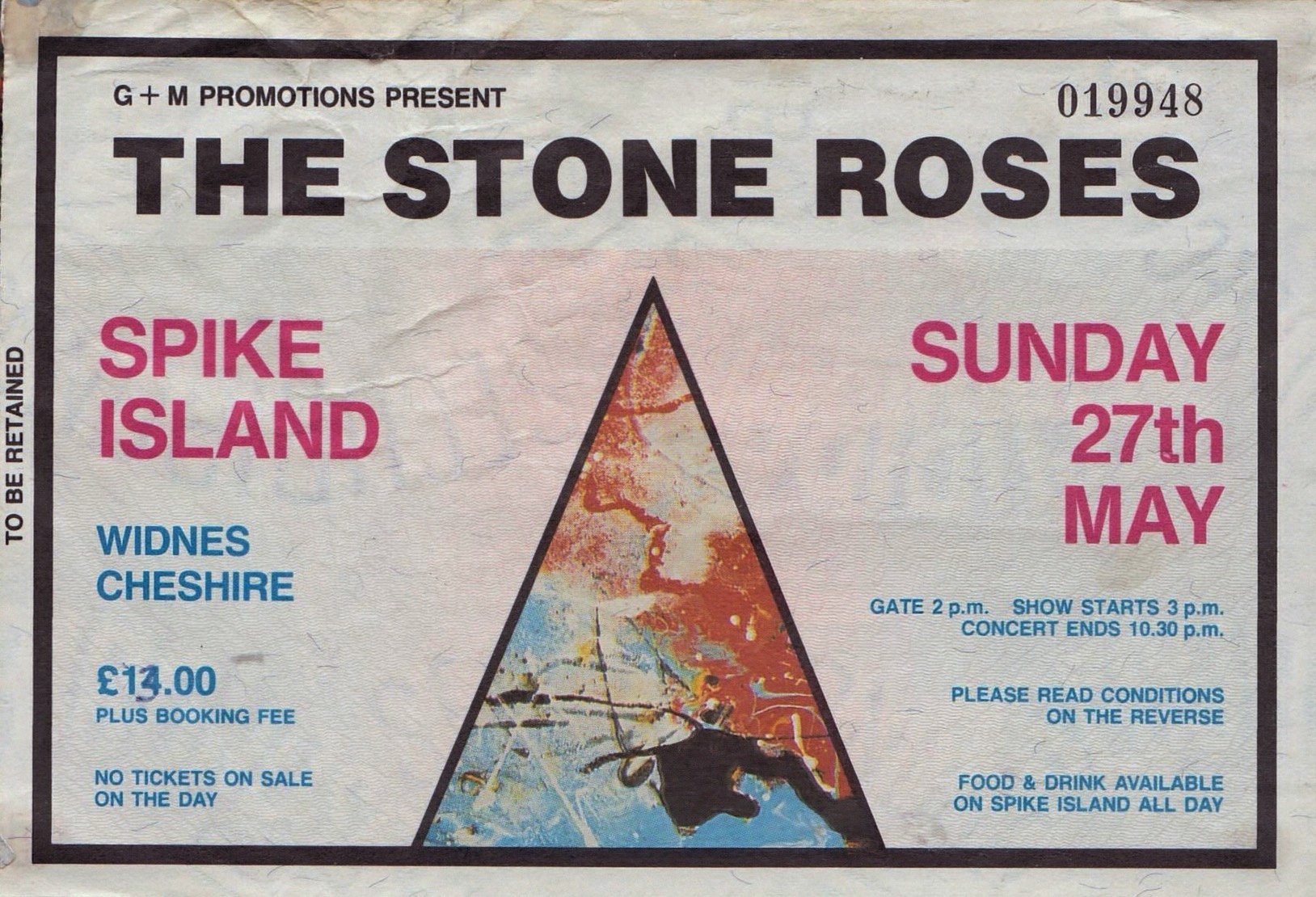
I still have my Spike Island ticket. Somewhere, I hope!
At the time, it was just a concert ticket. Thirty-five years on, it feels more like a passport stamp from another era. I had no idea how many of the bands I loved were connected, but it’s exactly this kind of ancestry and connection that I now find fascinating.
I knew I loved New Order. I knew that James, The Stone Roses and Electronic soundtracked my university years. I knew that Ever Fallen in Love by Buzzcocks was my favourite punk single, and that Love Will Tear Us Apart was the greatest pop song ever written (no, you shut up). What I didn't realise was that all those roads led back to the same city, the same scene, and even the same room.
School Days
I was born in January 1970 so slightly too young for punk's first explosion. Though I remember my older cousins having Never Mind the Bollocks I was far too sheltered for all that shenanigans. By the time I was discovering my love of independent music, Ian Curtis had already tragically passed and with that, Joy Division had drifted into myth and legend.
For me, the gateway into Manchester music took a much longer route.
I remember New Order at school, Blue Monday was the soundtrack of every teenage party. Thieves Like Us and True Faith; brilliant melodies, Peter Hook's distinctive bass lines, electronic experimentation, guitars, dance rhythms and an emotional depth that separated them from almost everybody else. Thanks to Annie Nightingale’s Sunday evening show on Radio 1, Temptation, Ceremony, and even Love Vigilante became favourites.
Lancaster and Madchester
When I arrived at Lancaster University in the late 80s, something remarkable was happening just down the M6. Manchester was becoming the centre of British music. The Second Summer of Love, acid house, the Haçienda, Madchester – all of it seemed to be happening at once, and we were only half an hour away.
I first saw James at Lancaster's Sugar House in 1990 just after they released Gold Mother, long before they became festival headliners. They were one of those bands that felt entirely their own thing; intelligent, unpredictable and utterly captivating live. I remember I wasn’t drinking that night but still felt hypnotised by their improvised energy and Tim Booth’s shamanic dancing.
I was also offered the chance to see The Stone Roses. And said no. I had a first-year exam the next morning. Looking back, this may rank among the great strategic errors of my youth. The incredible opening bars of I Wanna Be Adored can still take me back to 5pm on a Friday evening in the bar of Furness College every time I hear them.
Spike Island Comes Alive
Fortunately, life occasionally offers a second chance.
My old schoolmate Colin "Viv" Anderson managed to get tickets for Spike Island.
So, on Sunday 27 May 1990, I found myself travelling to a patch of wasteland in the middle of a river, in the middle of an industrial estate in Widnes with thousands of other Stone Roses fans.
The event has since become part of British music mythology; the ‘now legendary Spike Island gig’.
For those of us actually there, the sound quality was rubbish, the wind blew Ian Brown’s vocal all over the place, the organisation shambolic. In our youthful naivety the four of us were the only people not stoned and, when they finally did come on stage, I had the stench of a rotting banana under my feet all night.
But that's all beside the point. This wasn't simply a gig. It was an entire generation gathering around a band that somehow belonged to them. The Stone Roses were at their peak and, for one afternoon, it felt as if the world revolved around an island in the North of England, and thanks to Viv, I was that soldier!
Bernard Sumner and the god that is Johnny Marr
As if Manchester hadn't already provided enough of the soundtrack to my university years, Electronic arrived in my final year and another connection between Bernard Sumner and the god that is Johnny Marr was musical wish fulfilment. The first Electronic album became a defining record of my final student year, and I still cannot hear Get The Message without feeling the bittersweet, hollow inevitability of the best three years of my life coming to an end, mixed with the anxiety of whether a fledgling relationship would survive the fracture (and yes, dear reader, I married her).
Following the Wires Backwards
As I got older, my interest in New Order led me to explore, and love, Joy Division. And realise they were responsible for one of my favourite songs of all time, Love Will Tear Us Apart. Ironically of course based on the exact tragedy that was literally tearing Ian Curtis apart at the time. The more I listen, the more extraordinary Joy Division seem. Their records remain modern, powerful and haunting. They feel less like a band trapped in a particular moment and more like a signal still being transmitted.
Looking back, I see another connection that took years to reveal. For a long time, I admired the work of Anton Corbijn, through the Joshua Tree and U2. His black-and-white images, dramatic skies, industrial landscapes and ability to find beauty in melancholy have had a huge influence on my own photographic tastes. Only later did I realise how closely Corbijn's work was connected to the world of Joy Division. The visual aesthetic that attracted me to his photography was often the same aesthetic that surrounded the music.
And then I began to understand, Joy Division led to Factory Records, Factory Records to Tony Wilson, Tony Wilson and New Order to the Haçienda, the Haçienda to the Stone Roses, James, the Inspiral Carpets, the Happy Mondays, the Farm...
And working back, all those roads converge on two of the most famous gigs in British music history. My favourite ‘rock family tree’ story of all.
The Lesser Free Trade Hall
On 4 June and 20 July 1976, the Sex Pistols played Manchester's Lesser Free Trade Hall.
The audience was small. Whether it was forty people, a hundred people or somewhere in between almost doesn't matter. The significance of the gig wasn't that everyone suddenly wanted to sound like the Sex Pistols. The significance was that people suddenly realised they could, because let’s face it if the Sex Pistols...
What matters is who was there:
The shows were organised by local punk enthusiasts Howard Devoto and Pete Shelley, who had just formed the Buzzcocks. For years I have had Ever Fallen in Love as my favourite punk song.
Martin Hannett and Tony Wilson were there, who formed Factory Records.
Paul Morly, later NME journalist and member of Art of Noise was there.
Mark E. Smith, of the Fall, was there!
Even (and I love the incongruity) Mick Hucknall, of Simply Red.
Ian Curtis attended the second gig and met his childhood friends Peter Hook, Bernard Sumner, and Terry Mason, who would together form the band Warsaw which later became Joy Division.
And with Joy Division and Factory Records, the story of modern Manchester music began.
Factory Records
It's impossible to talk about Manchester music without talking about Tony Wilson. Television presenter, entrepreneur, evangelist, visionary and occasional chaos merchant, Wilson believed Manchester could be the centre of its own cultural universe. Factory Records became much more than a record label. It became a statement of intent. Together with producer Martin Hannett, designer Peter Saville, manager Rob Gretton and a remarkable collection of artists, Wilson helped build an entire ecosystem around independent music.
Even the sleeves mattered. Saville's artwork taught a generation that record covers could be art.
Factory wasn't simply documenting a scene.
It was creating one.
The Haçienda and New Order's Sacrifice
And then there was the Haçienda. One of the most influential nightclubs in British history. The Haçienda became the beating heart of acid house, dance culture and eventually Madchester. And yes, in another spectacularly dumb error I had the chance to go there on a college social night and chose not to – I mean who goes to a nightclub on a Tuesday night, right?
What fascinates me most is how much New Order sacrificed to keep it alive. Time and again, money earned from successful records found its way into supporting the club. From a business perspective, it was often madness. From a cultural perspective, it changed everything.
Without New Order's willingness to continue funding what frequently looked like a financial black hole, there might never have been a Madchester scene as we know it. In a very real sense, New Order paid for the party. The rest of us simply drank the champagne.
One More Manchester Moment
Many years later, Sarah and I went to the Manchester Apollo to see Neil Finn after he left Crowded House. I expected a solo show. Instead. I found myself watching something close to a supergroup. Artists including Phil Selway and Ed O'Brien from Radiohead suddenly appeared.
And when Johnny Marr walked on stage, the reaction was immediate. The place exploded.
A living god of a link in a chain stretching back decades, stood there in stonewashed denim.
The Family Tree and Why It Matters
The longer I've listened to music, the more I've become fascinated by these connections.
The family tree from the Sex Pistols, the Buzzcocks, Joy Division, New Order, Factory Records, the Haçienda, James, The Stone Roses, even via the Inspiral Carpets to a roadie called Noel Gallagher who forms a band with his brother… is my favourite of all.
What fascinates me isn't simply the music. It's the way culture grows. A small gig inspires a handful of people. Those people form bands. Those bands create records. Those records create clubs. Those clubs create scenes. Those scenes inspire another generation.
And all of that creates much of the soundtrack of my life, for some of the pivotal moments in it, for some of my happiest memories, for who I am as a person. Music is that evocative and powerful.
Whenever I find that Spike Island ticket tucked away in a drawer, I think about all those connections. A lonely schoolboy listening to New Order in an 80s bedroom. A student entranced by James at the Sugar House but stupidly missing out on the Hacienda and nearly the Stone Roses. A young man standing in a muddy field in Widnes wondering why there was a rotten banana under his feet. A much older man with less hair having time to discover and love Joy Division and even take up photography inspired in part by Anton Corbijn.
None of them realised they were part of a story that began fourteen years earlier in a small room at Manchester's Lesser Free Trade Hall.
I suppose that's the thing about connections. You rarely understand them when you're living them.
As both Electronic and James once sang, I've been getting away with it all my life.